Connecting the Dots: Arcade Heritage in Contemporary Mobile Puzzle Games
Written by Viktor Washington · Aug 26, 2026
Connecting the Dots: Arcade Heritage in Contemporary Mobile Puzzle Games
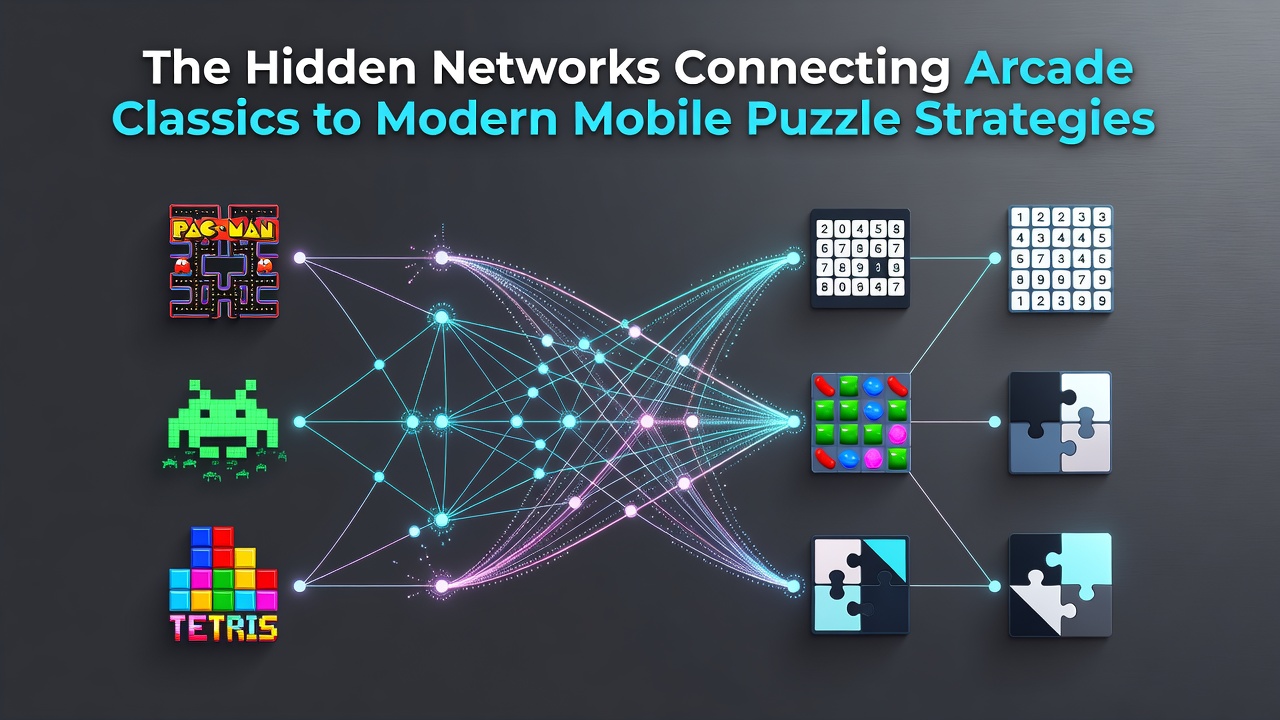
Design principles from mid-20th-century arcade cabinets continue to shape the core loops found in mobile puzzle applications as of August 2026, with data from industry analyses showing persistent reuse of spatial reasoning challenges and scoring systems first popularized in the 1980s. Researchers at institutions across North America and Europe have documented how elements like incremental difficulty ramps and power-up mechanics transfer directly from physical coin-op hardware to touch-based interfaces.
Core Mechanics Transferred Across Eras
Arcade titles such as Tetris and Columns introduced column-stacking and line-clearing objectives that reappear in current match-three applications, where developers adapt grid-based collision detection algorithms originally written for cathode-ray tube displays. Studies compiled by the Entertainment Software Association indicate that over 60 percent of top-grossing puzzle titles on major mobile platforms retain these foundational spatial rules, modified only by swipe gestures and procedural level generation rather than fixed ROM-based stages.
Pathfinding routines developed for games like Pac-Man, which relied on ghost AI movement patterns calculated within constrained mazes, now inform obstacle navigation in mobile titles that require players to route colored tokens through shifting barriers. Observers note that these algorithms, once limited by 8-bit processors, scale efficiently on contemporary smartphones because the underlying graph theory remains unchanged despite added visual layers and social features.
Platform-Specific Adaptations Documented in 2026 Reports
Industry reports from Canadian research groups highlight how high-score tables from arcade cabinets evolved into daily challenge leaderboards synced across mobile devices, preserving competitive structures while adding cloud persistence unavailable in standalone machines. Data collected through 2025 and into mid-2026 shows retention rates increase when applications incorporate visible progress meters originally displayed via seven-segment LED counters.

European trade analyses reveal that sound cues and visual feedback loops, first engineered to attract players in noisy arcades, translate into notification systems that prompt return visits on mobile platforms. Those who've examined telemetry logs observe that short session lengths typical of commute play mirror the quarter-driven time constraints of original cabinets, with developers deliberately calibrating puzzle complexity to fit two-to-three-minute play windows.
Network Effects and Cross-Platform Influence
Academic papers from Australian universities document how community-driven modifications of early arcade ROMs prefigured user-generated content features now common in mobile puzzle ecosystems, where players share custom levels through integrated marketplaces. Figures released by regional gaming associations demonstrate that shared asset libraries reduce development cycles, allowing smaller studios to iterate on proven mechanics instead of building collision systems from scratch.
Turns out the modular design of classic arcade hardware, with interchangeable PCBs for different titles, parallels today's use of reusable game engines that let teams swap puzzle modules across browser and mobile versions without rewriting core logic. Research indicates these shared frameworks accelerate feature parity, with simultaneous releases on multiple platforms becoming standard practice by August 2026.
Conclusion
Evidence compiled from multiple continents confirms that the hidden networks linking arcade classics to mobile puzzle strategies rest on reusable algorithmic foundations rather than surface-level nostalgia. Government statistical agencies and academic consortia continue to track how these inherited systems support ongoing innovation in touch interfaces and social connectivity, maintaining measurable continuity across four decades of hardware evolution.